A Practical Guide to Comparing supplier quotes with shipping and handling costs
The practical challenge is not adding a freight estimate to each unit price; it is making different supplier offers describe the same purchase and delivery outcome. A repeatable worksheet exposes mismatched units, missing services, and uncertain charges, then shows how those gaps affect the decision. Buyers can use it to ask focused questions before committing to a supplier.
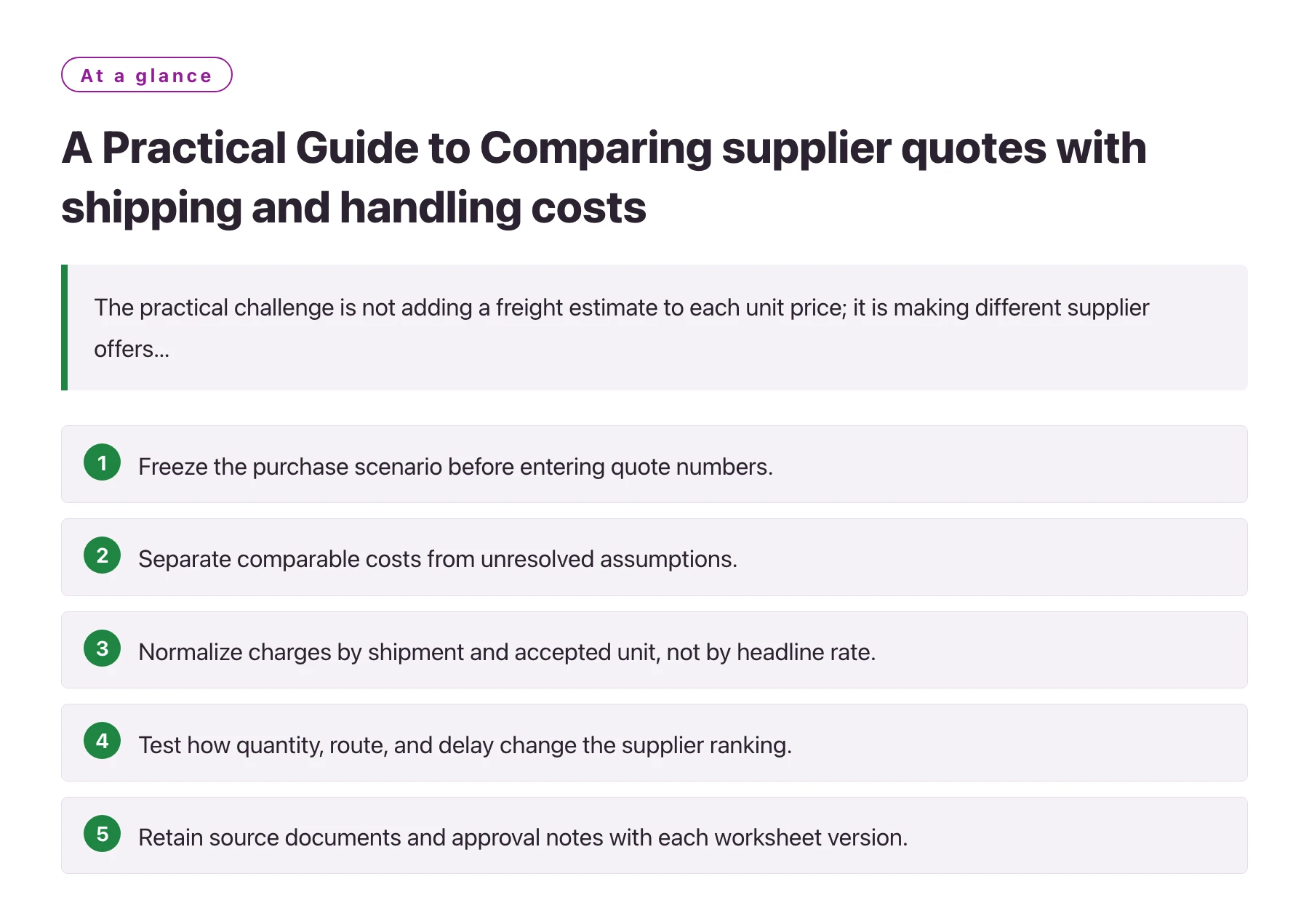
Key takeaways
- Freeze the purchase scenario before entering quote numbers.
- Separate comparable costs from unresolved assumptions.
- Normalize charges by shipment and accepted unit, not by headline rate.
- Test how quantity, route, and delay change the supplier ranking.
- Retain source documents and approval notes with each worksheet version.
A disciplined comparison keeps raw quotes intact while creating a normalized view with traceable adjustments and explicit uncertainty.
1. Freeze the scenario being priced
Choose one purchase case: product revision, quantity, pack-out, order date, ready date, origin site, final delivery point, and currency. Record whether the comparison covers a first order, repeat order, split release, or annual volume. Do not mix a small trial lot from one supplier with a full-container assumption from another.
Save the request package and identify its revision. When facts change, create a new worksheet version rather than silently replacing inputs. This allows reviewers to distinguish a supplier price change from a change in quantity, packaging, route, or delivery requirement.
2. Preserve raw quote data before normalizing
Enter each offer exactly as received: quoted unit, quantity tier, currency, named delivery point, quote validity, payment terms, included services, exclusions, and supplier assumptions. Attach the original file, email, or quote number. Keep supplier wording available beside the normalized fields.
This raw layer prevents an analyst from accidentally changing the meaning while converting units or filling gaps. Add a source note for every cost amount: supplier quote, forwarder estimate, broker advice, historical invoice, or internal assumption. Mark unknown items as unknown instead of entering zero.
3. Reconcile item and packaging units
Convert each price to the same commercial unit. For example, if one supplier quotes a carton and another quotes a piece, record pieces per carton and compare on the same accepted quantity. Check whether samples, accessories, protective components, labels, or spare parts are included in each pack.
Calculate shipping dimensions from the final carton and pallet configuration, not an early estimate. A change in packaging can alter chargeable volume, container utilization, handling labor, and damage exposure. Show the original unit and conversion formula so a reviewer can reproduce the result.
4. Build a cost-line bridge from factory to receipt
Create rows for product, tooling, packaging, factory pickup, export processing, origin terminal or consolidation, international freight, insurance, destination terminal, clearance, duty and nonrecoverable tax, local transport, unloading, and special handling. Use a consistent cost owner and service description on every row.
For each row, record amount, currency, charging basis, payer, confidence level, and included or excluded status. A fee charged once per shipment should remain a shipment-level amount until the model allocates it to the planned quantity. This makes the effect of order size visible.
5. Map delivery language to actual operations
Write the exact Incoterms® rule, edition, and named place when the contract uses one. Then list the actual services in the forwarder quote and the party expected to arrange them. ICC rules allocate specified tasks, costs, and risks, but the delivery acronym is not a complete rate sheet and does not identify every local fee. [1]
Check whether a named place is the factory, terminal, port, airport, or buyer warehouse. Confirm where handoff occurs and who covers activities before and after it. If quote wording and delivery term disagree, ask for clarification before treating a cost as included.
6. Calculate cost per shipment and accepted unit
First add one-time and recurring costs separately. Then calculate total cost for the defined order scenario. Divide by the quantity expected to be accepted and usable, not automatically by the order quantity, when inspection rejects, transit damage, or rework could materially reduce usable output. Show the yield assumption explicitly.
A useful formula is: total scenario cost = product and packaging + origin costs + main transport + destination charges + nonrecoverable import costs + receiving and quality costs. Unit scenario cost = total scenario cost divided by accepted usable units. Keep recoverable taxes or deposits visible but separate until finance confirms treatment.
7. Use ranges for volatile and unresolved costs
For freight, exchange rates, storage, or uncertain charges, enter low, base, and high values with dates and sources. Do not apply an arbitrary contingency percentage without saying what it covers. For customs classification or tax treatment, request qualified review rather than using a broad estimate as a final payable amount.
Compare both the likely case and an adverse-but-plausible case. If one supplier is cheapest only when every uncertain charge is at its low end, identify that dependency. A decision record should show whether the buyer accepts the exposure, obtains a firm quote, or chooses another route.
8. Stress-test quantity, route, and delivery delay
Calculate at the intended order size and at plausible lower or higher volumes. Shipment-level fees can dominate a small order and shrink per-unit cost at higher utilization. Test a split shipment or alternative mode only where the buyer could actually authorize it and the goods can be released separately.
Add the operational cost of lateness where relevant: missed launch, production interruption, expedited replenishment, or additional inventory. Show the source and logic rather than treating delay as a vague risk score. A different delivery date can reverse the apparent ranking even when the supplier price is unchanged.
9. Explain the difference between offers
Use a bridge table to explain why the totals differ: product price, package, freight basis, handling, duty assumption, or missing service. Send suppliers targeted questions about material omissions and ask them to revise the quote in writing. Preserve previous versions and responses for traceability.
Do not hide compliance, quality, capacity, payment, or warranty gaps inside a total-cost score. Screen mandatory conditions first. Then compare normalized cost, service reliability, schedule, quality evidence, and commercial risk. Record the selected scenario and the person approving it.
10. Reconcile after delivery and improve the next comparison
After receipt, replace estimates with actual supplier invoices, carrier invoices, customs statements, storage and handling bills, receiving labor, inspection costs, and damage or shortage records. Explain variances by the original cost line. Retain both estimate and actual so the next forecast can be calibrated.
Buyers using JS Sourcing landed cost planning can maintain a repeatable comparison from request through receipt. Review which quote questions produced useful answers, which assumptions were wrong, and which charges recur. Update the template while preserving earlier versions for open orders and audit records.
Sources
Frequently asked questions
Should unknown costs be entered as zero?
No. Mark them unknown, estimate a range with a source, or obtain a written quote before deciding.
Why keep the original supplier quotation?
It preserves the source wording and assumptions behind every normalized figure and later adjustment.
Should freight be divided by ordered units or usable units?
Use the basis that matches the decision; if yield losses matter, calculate per accepted usable unit and show the assumption.
When should a quote comparison be rebuilt?
Create a new version after material changes to product, quantity, pack-out, delivery point, route, or timing.