Small Payouts, Big Transactions: Planning a Coin Sweep
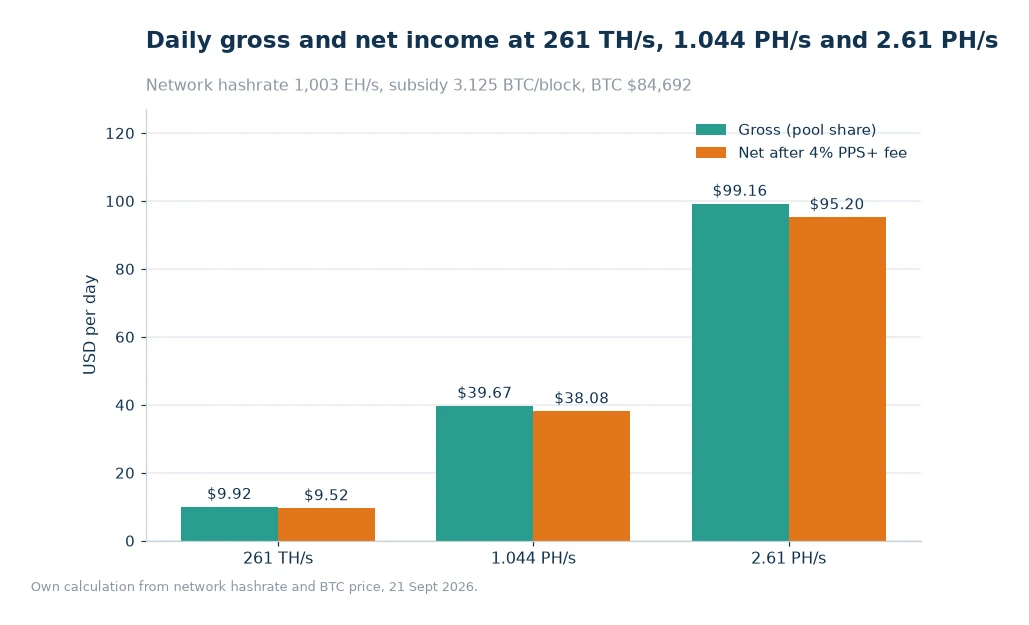
Hourly mining credits are wonderful for cash flow and awkward for wallet hygiene. Each settlement can become its own output, and a transfer that spends twenty of them is a much larger transaction than one that spends two. At 261 TH/s a day's credit is 0.00011709 BTC, worth $9.92 gross and $9.52 net, which is a useful reminder of how many small pieces a month can produce.

Key takeaways
- A free acceleration submission accepts 0.5 KB or less at 0.0001 BTC/KB or better, and a transfer built from many outputs can fail the size test alone.
- At 261 TH/s a day's credit is 0.00011709 BTC, so a 30-day month adds 0.00351258 BTC in small pieces.
- Consolidating on a quiet day costs less than consolidating during a fee spike, because the fee rate is set at broadcast.
- A sweep that spends an output which has not confirmed will be refused until the earlier transfer settles.
Why small payouts become heavy inputs
Bitcoin does not have accounts; it has outputs. Every time the pool credits you, the wallet receives an amount that must later be spent as a whole. Spend one and you create one input. Spend twenty and you create twenty, and the transaction grows with each one, which grows the fee at any given rate per kilobyte.
The value of the outputs does not matter to the size. Twenty credits of 0.0001 BTC produce the same weight as twenty credits of 1 BTC. That is the trap for a small miner: the transaction that moves a modest balance can be structurally larger than one that moves a fortune, simply because the balance arrived in more pieces.
The size test counts inputs, not coins
The free tier of the accelerator accepts transactions of 0.5 KB or smaller. An ordinary payment with one or two inputs sits comfortably inside that limit. A sweep built from a dozen hourly credits will usually exceed it, which means the free queue is closed even when the fee rate is generous. The limit is a proxy for complexity, and complexity is what inputs add.
This is why consolidation deserves its own plan rather than being folded into the next withdrawal. If the sweep is designed to fit inside 0.5 KB, it stays eligible for free acceleration and the cost question mostly disappears. If it is designed as one big monthly move of everything, it will need the paid route and the fee will scale with the number of pieces you left lying around.
| Sweep rhythm | Outputs spent | Estimated size | Free queue |
|---|---|---|---|
| Weekly | 4 | 0.35 KB | Yes |
| Fortnightly | 8 | 0.65 KB | No, too large |
| Monthly | 16 | 1.25 KB | No, too large |
| Quarterly | 48 | 3.70 KB | No, too large |
The weekly row is the interesting one. Four outputs fit, and the transfer stays inside the free tier if the wallet sets a competitive fee rate. Waiting a fortnight doubles the count and pushes the same sweep out of the free queue, which is a strange outcome: patience makes the transaction more expensive rather than less.
Timing the sweep inside the hour
On ViaBTC TX Accelerator, free submissions are served first in, first out within an hourly quota, and the quota refreshes each hour. That makes the first minutes of a window the safest time to submit, particularly when the mempool is busy. Submitting at fifty-five minutes past the hour risks waiting for the next window, which adds an hour to a process that was supposed to save time.
Pick a quiet period for the sweep as well. Fee rates are set when the transaction is broadcast, so a sweep during a congestion spike locks in a higher cost for the same work. Sunday mornings are a cliché for a reason, but any period when the mempool is thin will do; the point is to choose deliberately rather than to sweep whenever the balance looks large.
The unconfirmed-input trap
A sweep spends outputs, and an output that has not confirmed cannot be spent in a transaction the accelerator will accept. Mining credits normally confirm before they are spendable, but a chain of transfers between your own wallets can create a situation where the sweep is built on top of an unconfirmed parent. The tool refuses the child, correctly, because the parent does not exist on chain yet.
The fix is sequential: accelerate or wait for the parent, confirm it, then build the sweep. Wallets that make unconfirmed coins spendable encourage the mistake by showing a balance that is not yet real. If the sweep is urgent, spend only from confirmed outputs and leave the rest for the next batch.
What a sweep costs and saves
A sweep is not free, even at the free tier, because it consumes an hour of attention and creates a transaction that must confirm. What it buys is a smaller future. Every output removed today is a few dozen bytes that will not be paid for in every subsequent transfer, and the saving compounds over years of withdrawals.
There is also a privacy dimension worth a sentence, without turning it into a lecture. Combining many outputs links them together permanently, so a sweep that gathers mining credits into one address also announces that they belong to one owner. Miners who care about that should sweep to a fresh address rather than to the one the pool already knows.
Fees are the visible cost; the invisible one is the habit. An operator who sweeps four times a month never thinks about input counts again, because the count never grows to a size where it matters. An operator who sweeps once a year spends an evening reading about transaction weight and wondering why a move of a few hundred dollars needs the paid queue.
Watch the count, not the balance
A wallet shows a balance and hides the number of pieces behind it. Two wallets holding the same 0.01 BTC can hold it as one output or as forty, and only one of them will produce a small transaction when the time comes to spend. The count is the number that predicts the size of your next transfer.
Some wallets display it directly; others need a coin-control screen or an explorer lookup. Whichever route you use, check it before a withdrawal rather than after the fee estimate appears. A balance that grew steadily in small increments is a warning about the next transaction, not a sign of progress.
Worked example
The chart's three hashrates show how quickly the pile of small outputs grows, which is what makes the sweep necessary.
- A single terahash is worth 0.00000044865 BTC per day at 450 BTC over 1.003 billion TH/s.
- At 261 TH/s: 261 × 0.00000044865 = 0.00011709 BTC a day, or $9.92 at $84,692.
- Net after the listed 4% on the block-reward component: 9.92 × 0.96 = $9.52.
- Thirty days of daily credits: 30 × 0.00011709 = 0.00351258 BTC, or $297.49 gross.
- 1.044 PH/s, four machines: 0.00046837 BTC, $39.67 gross and $38.08 net a day.
- 2.61 PH/s, ten machines: 0.00117086 BTC, $99.16 gross and $95.20 net daily, 0.03512574 BTC across 30 days.
Frequently asked questions
Why does a small transfer sometimes fail the free size limit?
Because the limit applies to bytes rather than value. A transfer spending many small outputs can exceed 0.5 KB even when the amount moved is modest.
How often should mining credits be consolidated?
Often enough to keep each sweep within four to six outputs, which usually means weekly for a single machine rather than monthly or quarterly.
Can I consolidate outputs that have not confirmed yet?
No. A transaction spending an unconfirmed output cannot be accelerated, so the parent transfer has to confirm before the sweep is built.
Put the sweep on the calendar
Choose a day, choose an hour inside the quota window, and sweep only confirmed outputs into a fresh address. Four inputs is a reasonable target for a single machine; if the pile has grown past that, split the work across two weeks rather than forcing one large batch through the paid route.
Keep the destination in the multi-currency wallet so the sweep and the mining balance stay in one place, and check the current network conditions on the pool state page before broadcasting. If the batch grows beyond the free limit anyway, the paid route will still take it, but the cheaper answer is a smaller batch next time.
Sources: ViaBTC's wallet documentation and accelerator guide[1]. On 21 Sept 2026 the network read 1,003 EH/s, difficulty 132.76 T, subsidy 3.125 BTC, 144 blocks a day and BTC $84,692. Published 24 Oct 2026; byte sizes are estimates apart from the 0.5 KB limit.