Starting a Niche Fragrance Brand: The Decisions That Matter First
A niche fragrance brand is not defined by producing small quantities or charging high prices. It is defined by having a point of view that a specific group of customers recognises and returns to. Everything else, including the size of the first production run, follows from that. Founders who plan the scent territory, the range structure and the sales channel before commissioning packaging make far fewer expensive mistakes.
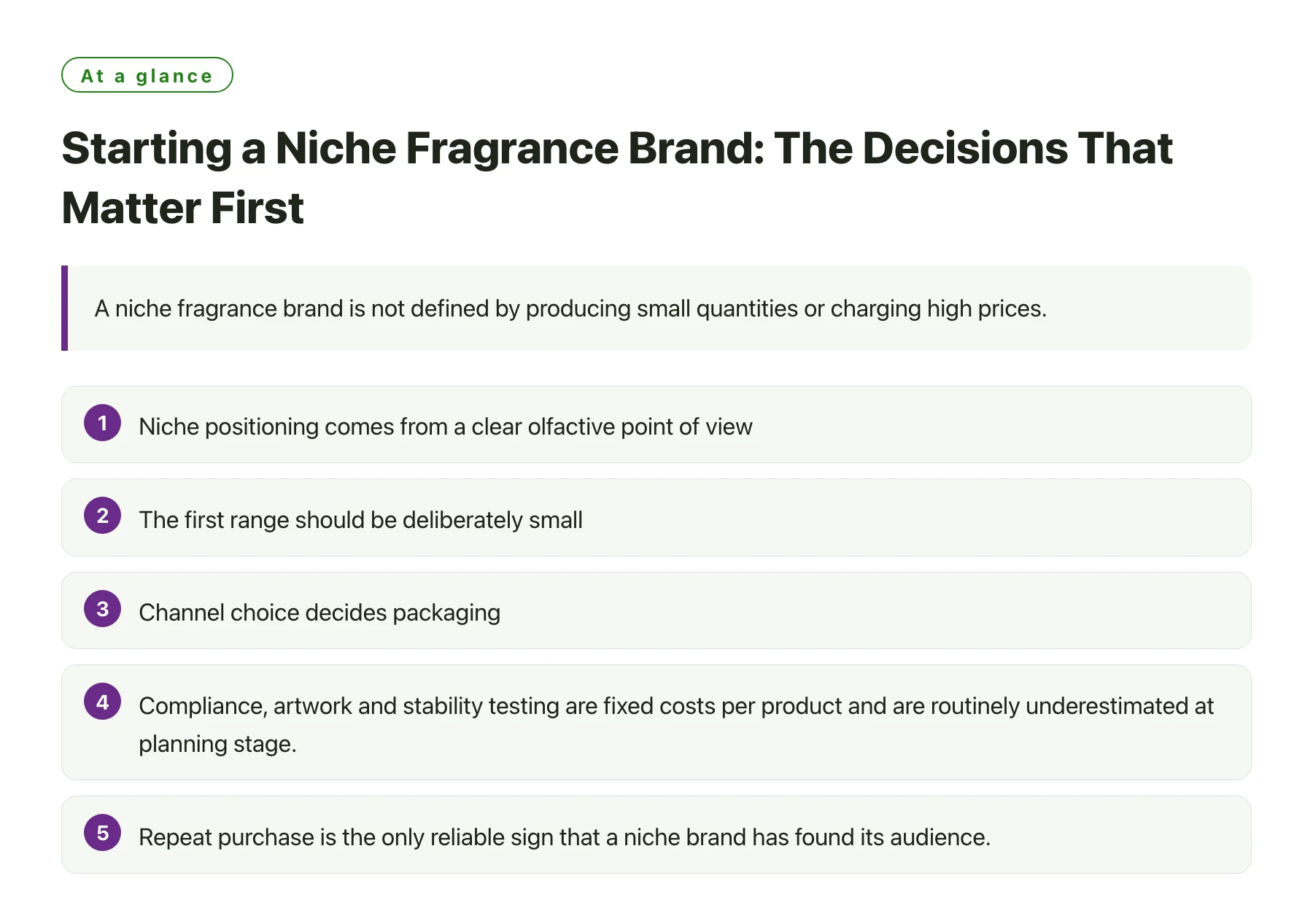
Key takeawaysNiche positioning comes from a clear olfactive point of view, not from a small production run or a high price. · The first range should be deliberately small, because each additional scent multiplies development, compliance and stock costs. · Channel choice decides packaging, price architecture and how much of the margin stays with the brand. · Compliance, artwork and stability testing are fixed costs per product and are routinely underestimated at planning stage. · Repeat purchase is the only reliable sign that a niche brand has found its audience.
Most people who start a fragrance brand begin with an image: a bottle, a name, a mood. Those are the outputs of a positioning decision that has not been made yet, and starting there usually means rebuilding the project once the first samples arrive.
The founders who last tend to work in a different order. They decide what territory they intend to occupy, who they are speaking to, how the products will reach those people, and only then commission the pack that carries the message.
This article sets out that order and the points where first-time founders most often spend money in the wrong place.
What niche actually means in commercial terms
The word gets used loosely, so it is worth being precise. In practice a niche brand is one whose appeal is narrower and more specific than a mass fragrance, and whose customers are willing to pay for that specificity.
That has consequences for every decision downstream, including how many products the brand can support.
A narrow promise, clearly stated
A niche brand should be describable in one sentence that a customer would repeat to a friend. If the sentence requires the word and, the territory is probably too broad for a first range.
This is not a marketing exercise. It determines the materials the perfumer works with, the references in the brief, and the packaging that fits the story. The brief becomes much easier to write once the sentence exists.
Repeat purchase, not first-sale volume
A launch can generate attention and still fail, because the economics of a small brand depend on customers coming back. Consumer research published by Mintel's press centre covers beauty and personal care buying behaviour and is a useful reality check on what customers say they want versus what they buy [1].
For a new brand, the practical implication is to design the first range so that at least one product is easy to repurchase and easy to recommend. A single dramatic signature scent with no obvious repeat companion is a harder business than it looks.
The range size is a strategy decision
Every additional scent adds development rounds, a compliance file, artwork, a retained sample routine and stock that has to be financed. Three products can be a coherent collection; nine products for a first launch usually means nine half-supported products.
Starting small and adding a scent once the first one has repeat customers is a slower-looking route that is considerably cheaper to correct.
The order of decisions for a first launch
- Write the one-sentence territoryDefine the olfactive and emotional space you intend to own, in plain language, before any sampling.
- Choose the customer and the channelDecide whether the product sells online, through selected retail or both, because that choice constrains packaging and price.
- Set the price architectureWork backwards from the retail price to a cost ceiling that covers fragrance, packaging, compliance and logistics.
- Fix the size of the first rangePick the smallest range that tells the story, and resist adding a scent before the first one has reorders.
- Select the development modelDecide between OEM and ODM based on how much development work your team can genuinely carry.
- Plan compliance and artwork lead timesBudget the safety assessment, allergen declaration and print lead times as project tasks with dates, not as afterthoughts.
Where first-time founders spend money badly
Almost every overspend in a first fragrance launch falls into one of three patterns, and none of them is about the scent itself.
Recognising the pattern early is the most direct way to protect the launch budget.
Paying for a custom bottle before the scent is settled
A custom mould is one of the largest single commitments in the project and the hardest to change. Committing to it before the formula is approved means the pack is fixed while the product is not.
A standard bottle with good decoration can carry a premium product perfectly well for a first launch. If the brand grows, the custom pack becomes a second-generation decision with real revenue behind it.
Overbuilding the range
Launching six scents because the perfumer presented six good options is a common and expensive mistake. Each one needs its own development file, its own compliance work and its own shelf space in the customer's mind.
A useful test is whether you can explain each product's reason to exist in one line, without reference to the others.
Skipping the boring work
Stability testing, allergen declaration, transit testing and retained samples feel like overhead when the exciting part is the scent. They are also the items that turn into recalls, reprints and refunds when they are missed.
Founders often underestimate how much of the timeline these tasks consume, because they run in parallel with everything else and depend on other people's lead times.
Working with a manufacturer such as Xuelei Fragrances reduces that risk for a simple reason: the formula, the filling and the packaging sit with one team, so a missing document tends to surface during the project rather than at the port.
Budget categories, and where the money usually goes wrong
| Category | Where founders overspend | What deserves the money | Why it matters |
|---|---|---|---|
| Fragrance development | Repeated sampling without a written brief | A clear brief and enough rounds to test on skin | The scent is the product; vague briefs multiply rounds |
| Bottle and closure | Custom moulds before the formula is fixed | Good decoration on a reliable standard bottle | Tooling is hard to reverse, decoration is not |
| Secondary packaging | Heavy boxes that fail transit anyway | Tested protection and clean print | Damage costs more than material savings |
| Compliance and testing | Nothing, until a document is missing | Safety assessment, allergen list, stability work | Missing documents block market entry and retail listings |
| Inventory | Too many scents in small quantities | Fewer products, deeper stock | Stock ties up cash and ages on the shelf |
| Brand and content | A single expensive campaign | Consistent photography and clear product copy | Repeat customers are built by clarity, not one burst |
Notice that the second column is mostly about doing things too early or too widely, and the third is mostly about doing a smaller number of things properly. That is the shape of a first launch: narrow the scope, deepen the work, and keep the reversible decisions reversible for as long as possible.
The most valuable piece of advice for a first range is to leave something out. A collection of two or three scents that share a clear territory and are properly documented will outperform a collection of eight that were each developed in a hurry, both with customers and with any retailer you approach. Decide which single product is the signature, which one is the easy repeat purchase, and which one, if any, is the experiment, then put the compliance and testing budget behind all of them equally. Brands that start narrow and add deliberately usually find the second launch far easier than the first.
Sources
- Mintel Press Centre —— Mintel's press releases on consumer and beauty market research, including fragrance and personal care trend reporting.
Frequently asked questions
How many fragrances should a new niche brand launch with?
The smallest number that communicates the brand's territory, which for most founders is two or three. Each additional scent adds development, compliance, artwork and inventory costs, and a small range executed properly generally performs better than a wide range produced in a hurry.
How much does it cost to start a perfume brand?
Cost depends on the range size, the packaging and the market you intend to sell in, so any single figure would be misleading. Build the budget from four blocks instead: development, packaging and tooling, compliance and testing, and the first production run plus inventory.
Do I need a custom bottle to look like a niche brand?
No. A standard bottle with well-executed decoration reads as considered rather than generic, and it keeps the project reversible while the formula is still changing. A custom mould is a reasonable second-generation decision once the first product has paying repeat customers.
What is the biggest hidden cost in launching a fragrance?
Compliance and testing work, followed by artwork lead times. These items are fixed per product rather than per unit, they depend on other people's schedules, and they are easy to forget while the scent and the packaging are being decided.
Should I work with a manufacturer or an independent perfumer first?
Both models work, and the sequencing matters more than the choice. A manufacturer that also fills and packs can carry formula, bottle and filling decisions together, which is efficient for a first launch. Independently developed formulas can then be manufactured to specification once the brand has a clear technical brief.