Why should traders watch the bitcoin halving countdown?
The Bitcoin halving is a transparent and immutable monetary policy experiment based on a fixed frequency of 210,000 blocks. With four historical events recorded in 2012, 2016, 2020, and 2024, the bitcoin halving countdown serves as a vital data hub for researchers. By tracking real-time network hashrate and difficulty adjustment cycles, the platform transforms static countdowns into dynamic, interactive charts that quantify supply shocks, historical price drawdowns, and inflation rate differences compared to gold and the US dollar.
Understanding network output speed requires moving beyond calendar-based assumptions toward a focus on block height and network health. The platform monitors real-time hashrate and average block times to provide high-precision countdowns that reflect the actual progression of the Bitcoin protocol.
The Bitcoin halving is not merely a countdown but a repeatable monetary experiment that occurs every 210,000 blocks.
This precise tracking of the network’s internal mechanics provides the foundational data necessary for analyzing how mining output changes influence market supply-side dynamics.
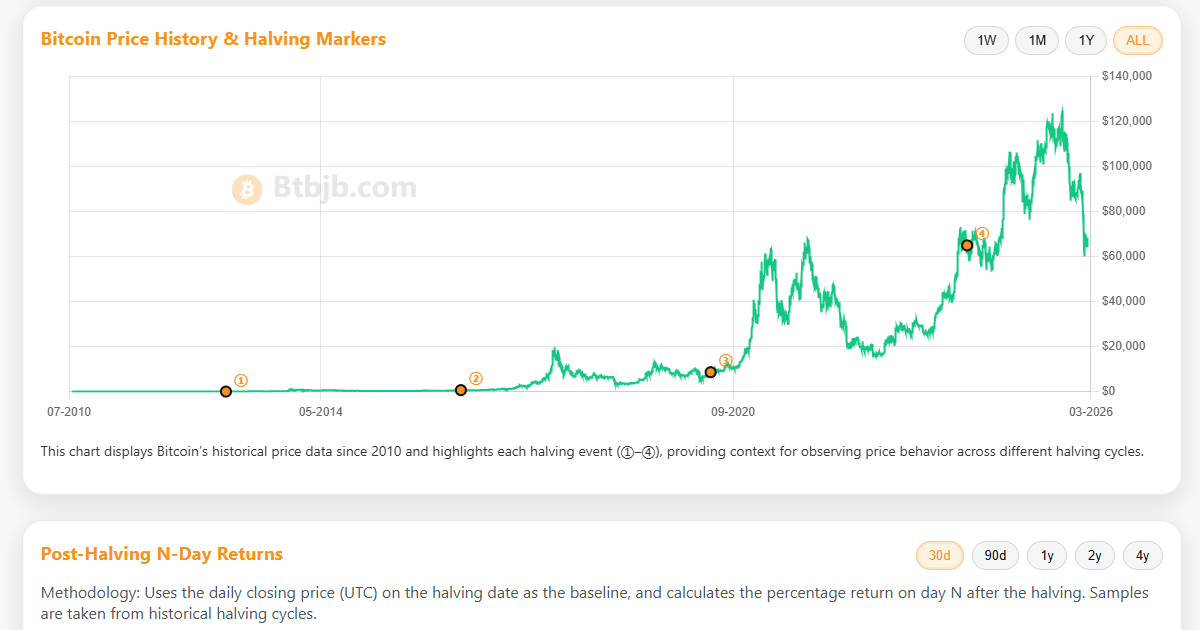
With accurate timing established, historical replay tools allow users to identify patterns across different cycles. The historical price and halving node interaction chart supports data points from 2010 through 2026, offering a clear view of how market structures evolve around these milestones.
| Halving Event | Historical Context | Analysis Focus |
| 2012 | Initial cycle | Early supply contraction |
| 2016 | Secondary cycle | Volatility and adjustment |
| 2020 | Mature cycle | Institutional engagement |
| 2024 | Recent cycle | Supply shock evolution |
Users can zoom into specific timeframes to compare how price trajectories formed before and after each event, avoiding the limitations of static imagery.
Beyond price trends, quantifying market performance after a halving reveals how supply shocks actually impact asset valuation. The distribution charts display performance across 30-day, 90-day, 180-day, and 365-day windows.
These tools help decompose the "halving means immediate surge" myth by visualizing the time windows required for supply shocks to translate into market performance.
This data-driven approach allows observers to view historical performance through a rational lens, identifying the timeframes where market participants historically reacted to reduced issuance.
Managing exposure requires an understanding of downside risk, which is why visualizing historical drawdowns is essential. Comparing the depth of price declines during different cycles provides a psychological baseline for the "shakeout" periods often associated with these transitions.
Visualizing the extreme drawdowns of 2016 or 2020 helps participants understand the periods of stress experienced by the asset during its path toward new highs.
This form of risk analysis allows for the development of expectations grounded in historical facts rather than speculation.
Market behavior also appears to have cyclical components when analyzed across a decade of daily data. By identifying clusters of days where Bitcoin has historically shown the highest or lowest performance, researchers can view the asset's seasonality.
Analyzing over ten years of daily price change data reveals specific clusters of strong or weak performance throughout the year.
While past behavior does not guarantee future results, this statistical perspective offers a unique angle for studying global liquidity cycles.
To further grasp the asset's long-term utility, calculating the time required to recover from losses is a practical metric. Tools that measure how long it takes for a price to return to a profitable zone from various entry points provide insight into the "time value" of decentralized assets.
Long-term holders often utilize these recovery period calculations to establish a mindset centered on the asset's persistence.
This functionality assists users in understanding the structural recovery path of the asset after it has faced significant price pullbacks from previous peaks.
Finally, the macro perspective remains crucial, as Bitcoin is often evaluated against traditional stores of value. Real-time dashboards monitor the current issuance rate as it approaches the 21-million-coin cap, while calculators compare the inflation rate of Bitcoin against that of fiat currencies.
When the block reward decreases from 3.125 to 1.5625 BTC, the platform allows for real-time comparisons of inflation differentials.
By contrasting Bitcoin with the erosion of purchasing power in the US dollar and its competitive position against gold, the platform provides the context needed to assess the asset's role in a broader economic framework.